
How to compare IP water resistance ratings for audio gear
Advertisements
Comparing IP water resistance ratings allows you to determine whether a pair of earbuds or a portable speaker can survive sweat, heavy rain, or accidental immersion before you spend your money. Understanding these codes helps outdoor listeners, gym enthusiasts, and budget-conscious shoppers identify real hardware protection rather than relying on vague promotional marketing terms like water-resistant or weatherproof.
The main catch is that laboratory tests rely on controlled fresh water at room temperature, meaning an official rating does not guarantee protection against pool chlorine, ocean salt, hot shower steam, or high-pressure jets. Furthermore, nearly every consumer electronics brand excludes liquid damage from its standard limited warranty, leaving the replacement cost entirely on you if seals fail.
The basic anatomy of an ingress protection code
Ingress Protection ratings, commonly abbreviated as IP ratings, follow the international standard set by the International Electrotechnical Commission under standard 60529. This standardized classification system provides an objective measure of how well an electronic enclosure prevents external solids and liquids from reaching sensitive internal circuit boards. When shopping for audio hardware in the United States, you will almost always see the letters IP followed by two specific digits or an X placeholder, such as IPX4, IP67, or IPX8.
Advertisements
The first character following the letters IP measures protection against solid objects, ranging from large debris like pebbles to microscopic dust particles. This mechanical scale runs from zero, meaning zero mechanical protection, up to six, which denotes complete dust tightness under continuous vacuum testing. If a company does not submit its product for certified dust testing, it replaces this first digit with the letter X. An X does not signify zero protection; it simply confirms that the manufacturer chose not to pay an accredited laboratory to certify dust resistance.
Advertisements
The second character indicates the level of liquid moisture resistance, scaled from zero through nine. Consumer headphones and portable speakers focus primarily on levels four through eight, which address everything from light rain splashes to continuous underwater submersion. When you evaluate audio gear, analyzing both characters independently ensures you do not mistake splash resistance for comprehensive element sealing.
Decoding common liquid resistance digits on audio hardware
Audio gear designed for daily workouts or travel generally features moisture resistance levels between four and eight. Identifying the differences between these tiers prevents you from assuming that a splash-proof product can handle complete submersion or that a fully submergeable device resists pressurized water streams.
Liquid protection tiers for consumer electronics
- IPX4 protects internal drivers from splashing water coming from any direction for at least ten minutes, making it the minimum reliable standard for running in light rain or sweating during gym workouts.
- IPX5 protects enclosures against low-pressure water jets delivered from a standard nozzle for three minutes, allowing you to wipe down a speaker with a damp cloth or use it near a bathroom sink.
- IPX6 withstands powerful water jets delivered through a larger nozzle at higher pressure, preventing water entry from sudden outdoor downpours or heavy deck splashes.
- IPX7 permits temporary submersion in fresh water up to a depth of one meter, roughly 3.3 feet, for up to thirty minutes without fatal leakage.
- IPX8 certifies continuous submersion in water deeper than one meter, with exact depth and duration limits defined and published by the manufacturer.
A crucial technical nuance of the IEC 60529 standard is that liquid immersion tests do not automatically satisfy spray or jet tests. A speaker rated strictly as IPX7 has demonstrated survival during quiet underwater immersion, but it has not necessarily passed the pressurized jet testing required for IPX6. Products that satisfy both continuous water streams and deep submersion must carry dual certifications on their official packaging, such as IPX6/IPX8.
Why dust ratings matter for outdoor speakers and beach use
Dust and fine debris pose just as much risk to mobile audio electronics as moisture, particularly for portable speakers brought to parks, campgrounds, or coastal beaches. Fine quartz beach sand can easily work its way through open speaker grilles, while airborne trail dust can coat micro-USB and USB-C contact pins, leading to electrical shorts or mechanical port failures.
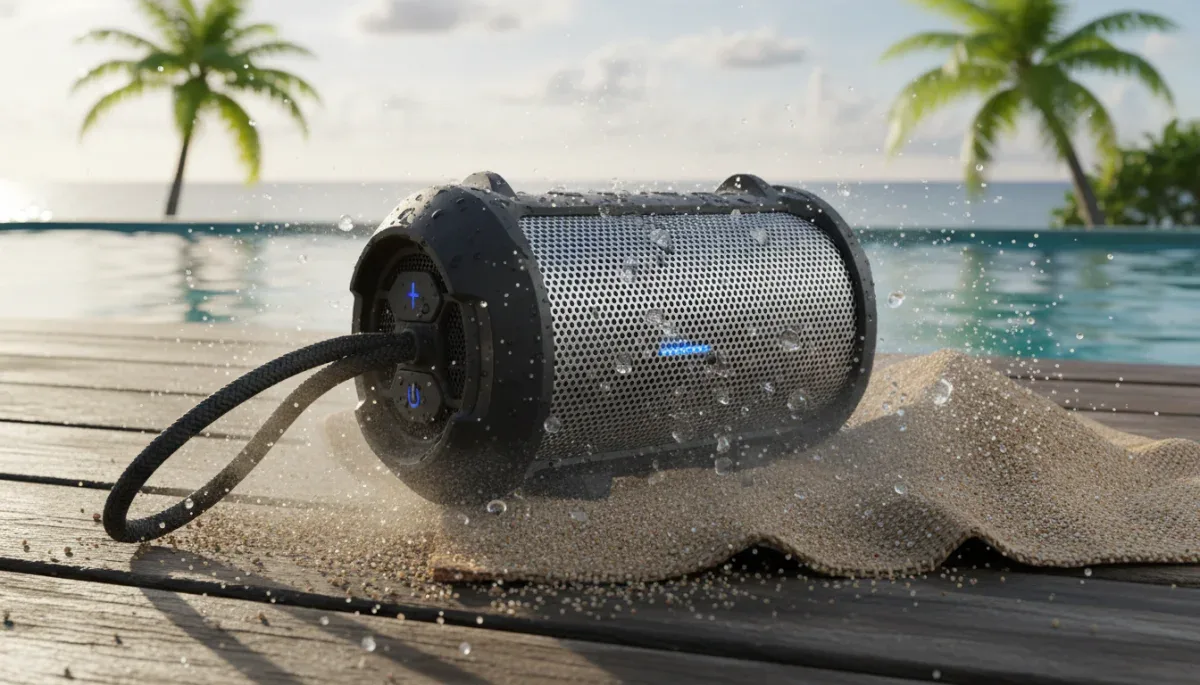
Solid ingress testing uses dry talcum powder circulated inside a closed test chamber for up to eight hours to evaluate whether tiny particles can infiltrate the enclosure. A solid rating of five indicates dust-protected design, meaning small amounts of fine dust may enter the shell but will not interfere with safe electrical operation. A rating of six represents complete dust-tight performance, ensuring that zero particulate matter penetrates the structural housing.
If you regularly attend outdoor sporting events, hike sandy trails, or place your audio gear on picnic tables, prioritizing an IP67 or IP68 rating over an IPX4 rating provides critical mechanical insurance. Earbuds carried inside pockets and backpacks also benefit from solid-particle ratings, as accumulated pocket lint can degrade acoustic mesh filters and weaken ear-tip acoustic seals over months of daily carry.
Laboratory testing environments versus real-world hazards
Every official ingress test takes place within sterile, controlled engineering environments using calm, non-carbonated fresh water at room temperatures between 59 and 95 degrees Fahrenheit. Devices sit stationary or undergo slow rotation under balanced atmospheric pressure. Outside the laboratory, real-world conditions introduce chemical, thermal, and dynamic forces that standard testing does not replicate.
Saltwater represents one of the fastest routes to hardware degradation. When ocean water touches electronic copper contacts and aluminum grilles, salt crystals remain behind as the moisture evaporates, causing rapid electrochemical corrosion and drying out rubber silicone gaskets. Similarly, chlorinated swimming pools contain oxidizing chemicals that break down soft synthetic polymers over repeated exposures, gradually softening the water-resistant seals around speaker buttons and charge doors.
Temperature changes present another hidden danger for bathroom and shower listening. Hot water creates microscopic water vapor molecules that penetrate tight enclosures far more readily than cold liquid droplets. When steam cools inside an earbud chamber or speaker housing, it condenses directly onto microchips as liquid moisture, creating internal corrosion on hardware that technically carries an IPX7 submersion certification.
Reading warranty fine print and water damage policies
Before using water-resistant earbuds or speakers around water, inspect the written limited warranty provided in the box or on the brand's official website. Despite bold advertising campaigns showcasing runners caught in thunderstorms or athletes washing earbuds in sinks, consumer warranties almost universally exclude coverage for liquid intrusion.
Inside the chassis and charging bays of portable audio devices, manufacturers place small Liquid Contact Indicators. These chemical inspection strips turn from pale white to bright red or pink when moisture contacts them. If you submit a malfunctioning speaker for warranty repair and the technician discovers a triggered indicator, the claim is routinely denied, leaving you responsible for replacement expenses regardless of whether the device held an IPX8 badge.
Mechanical wear also degrades physical ingress protection over time. Dropping a speaker onto pavement can misalign internal rubber o-rings, while exposure to skin oils, sunscreen, and cleaning chemicals gradually hardens flexible port covers. Water resistance is a temporary engineering feature that slowly diminishes through everyday friction, rather than a permanent physical property of the hardware.
Practical steps for preserving moisture seals on audio equipment
Maintaining the structural integrity of internal silicone gaskets requires basic post-exposure care whenever audio hardware encounters moisture. Following consistent maintenance steps prevents trace liquids from creeping across sensitive terminal connections.
Care routines after liquid exposure
- Rinse the exterior of IP67 or IP68 rated gear with a gentle trickle of fresh tap water if it comes into contact with ocean salt, sports drinks, or pool chemicals.
- Dry the exterior thoroughly using a clean, lint-free microfiber towel before opening any rubber charging doors or placing earbuds back into their battery case.
- Allow damp ports to air-dry completely for several hours in a room with adequate air circulation before connecting any power cables.
- Inspect integrated rubber port plugs periodically to confirm that the perimeter gaskets remain supple, uncracked, and free of dirt accumulation.
Never connect a charging cable to an earbud stem or speaker port while moisture remains present inside the socket. Even if the internal circuitry remains sealed, introducing electric current across wet external copper pins causes rapid electrolytic corrosion, which permanently destroys the charging functionality of the device.
At a glance
| IP rating level | What to know |
|---|---|
| IPX4 | Handles light workout sweat and minor rain splashes, but cannot withstand pressurized water jets or direct water immersion. |
| IP67 | Provides total sealing against microscopic dust and tolerates fresh water immersion up to one meter for thirty minutes. |
| IP68 | Offers complete dust protection and continuous fresh water submersion beyond one meter according to manufacturer-defined depth parameters. |
| Warranty status | Standard manufacturer warranties generally exclude liquid damage despite certified laboratory ingress ratings. |
Frequently asked questions
Can I wear IPX8 earbuds while swimming in a pool?
No, swimming with IPX8 earbuds is generally not recommended unless the manufacturer explicitly certifies them for swimming use. Chlorine damages internal rubber seals, water movement creates pressure spikes that exceed static laboratory depth ratings, and Bluetooth wireless signals cannot reliably travel through water.
What does the letter X mean in an IP rating?
The letter X means the manufacturer did not submit the device for official testing against solid particulate ingress. It does not indicate zero dust protection, but it confirms that the device lacks certified lab data for dust resistance.
Are water-resistant earbuds protected against hot shower steam?
No, standard ingress testing uses cold fresh water and does not certify protection against vaporized steam. Warm vapor readily penetrates flexible acoustic seals and condenses into liquid water inside the cold earbud chamber, causing internal electrical failure.
Does a higher water rating cover liquid damage under warranty?
No, consumer audio warranties almost universally exclude repairs for liquid intrusion regardless of the certified IP tier. If moisture triggers the internal liquid contact indicator strip, service centers will reject your warranty claim.
The bottom line
Comparing IP ratings requires looking past broad retail marketing and verifying the exact numbers certified under official IEC standards. For standard gym sessions and outdoor runs, an IPX4 rating provides adequate protection against sweat, while poolside speakers and trail gear demand the comprehensive dust and immersion safety of IP67 or IP68. Before purchasing any audio hardware for wet environments, check the manufacturer's official warranty document to confirm their specific repair exclusions regarding water ingress.

Written by
Mariana Viana
Mariana Viana covers discounts and savings for S2YOU, from coupons and cashback to free-trial and sample programs. She compares offers and program rules across retailers, and checks every detail on the brand's official site before publishing.