
How to Compare Power Bank Specs Before Buying Online
Advertisements
To compare power bank specs effectively, you must evaluate nominal capacity against real usable energy, verify the wattage output for each individual port, and ensure the charging protocols match your specific devices. Comparing these technical details prevents common shopping mistakes, such as buying an external battery pack that charges your phone at sluggish baseline speeds or fails to power a laptop altogether.
This technical breakdown helps online shoppers who want reliable backup power without overpaying for inflated marketing claims, though it requires checking the fine print on product specification sheets before placing an order. Budget retailers and online marketplaces feature thousands of external batteries, but the numbers printed in bold headlines rarely tell the complete story about real-world performance.
Decoding battery capacity and realistic energy conversion
The headline capacity of any external battery is almost universally listed in milliampere-hours (mAh). A portable charger advertised at 10,000 mAh sounds like it can recharge a standard 3,300 mAh smartphone battery three full times, but physical conversion losses prevent this. Internal lithium-ion or lithium-polymer cells operate at a nominal voltage of roughly 3.7 volts, whereas standard USB charging outputs power at 5 volts, 9 volts, or higher levels.
Advertisements
When the internal circuitry converts that 3.7V nominal energy to a 5V USB output standard, usable capacity drops. In addition, resistance inside the charging cable, energy lost as ambient heat, and the receiving phone's internal charging circuit further reduce overall efficiency. In practical conditions, a quality battery pack delivers between 60 percent and 70 percent of its stated milliampere-hour rating directly into your connected hardware.
Advertisements
Core capacity metrics to analyze
- Stated milliampere-hours: The raw electrical charge stored across the internal battery cells at nominal cell voltage.
- Watt-hour measurement: The actual total energy capacity calculated by multiplying amp-hours by nominal cell voltage.
- Usable output capacity: The net energy delivered to devices after voltage stepping and thermal dissipation losses.
- Cell chemistry configuration: The arrangement of internal pouch cells or cylindrical cells that dictates longevity and energy density.
To find the true capacity before ordering, look for the watt-hour (Wh) rating on the technical specification label. A standard 10,000 mAh battery rated at 3.7 volts holds 37 watt-hours of raw electrical energy. Comparing watt-hours gives you a direct, unskewed measurement that bypasses confusing voltage adjustments.
Matching output wattage and fast-charging protocols
Capacity tells you how much energy a battery stores, but output wattage determines how quickly that energy flows into your electronics. Standard legacy USB charging tops out at 5 watts (5V/1A) or 10 watts (5V/2A), which results in slow charging cycles for modern devices. Contemporary smartphones and tablets rely on dynamic fast-charging protocols that communicate directly with the power bank to supply higher voltage and current.
The most versatile open standard is USB Power Delivery (USB PD), usually implemented over a USB-C connection. USB PD negotiates power profiles such as 9V/2A (18W), 9V/3A (27W), or 20V/5A (100W). If you want to charge a modern smartphone at top speed, the power bank should supply at least 20 to 30 watts over USB PD. For ultraportable laptops, look for a minimum sustained output of 45 to 65 watts from a single port.
Common fast-charging standards found in specs
- USB Power Delivery (PD): The universal cross-platform fast-charging standard required for modern iPhones, iPads, Google Pixel devices, and USB-C laptops.
- Programmable Power Supply (PPS): An advanced subset of USB PD that adjusts voltage in tiny increments to prevent device overheating on compatible Samsung models.
- Quick Charge (QC): A proprietary Qualcomm standard widely used in older Android accessories and multi-port charging hubs.
- Proprietary flash charging: Brand-specific protocols found on certain overseas phone models that require matching branded battery packs to hit top speeds.
Always verify whether the advertised wattage applies to a single port or represents the combined total across all ports simultaneously. Many budget power banks advertise "30W Total Output," which actually splits into 15W per port when two devices are plugged in, cutting your charging speed in half.
Examining port configurations and recharge speed
The physical ports on a portable battery dictate convenience, compatibility, and versatility. Older power bank models often feature micro-USB ports strictly for recharging the pack itself, alongside full-sized USB-A ports for output. Modern hardware designs favor bidirectional USB-C ports that handle both incoming power to recharge the battery and outgoing power to charge your devices.
Input speed is just as important as output speed. A large 20,000 mAh battery that accepts only standard 10W input can take ten to twelve hours to fully recharge from empty. Conversely, a power bank supporting 30W or 65W USB-C PD input can recharge completely in two to three hours when connected to a compatible wall adapter.
Port features to review before purchasing
- Bidirectional USB-C ports: Single connectors capable of both receiving recharging current and delivering power to external hardware.
- Pass-through charging: Circuitry that allows the power bank to charge connected accessories while the internal battery itself is plugged into the wall.
- Low-current trickle mode: A specialized power profile designed to charge small accessories like wireless earbuds or smartwatches without shutting off automatically.
- Dedicated legacy ports: Standard USB-A jacks provided for older charging cables and non-PD peripheral accessories.
Check the product manual or digital listing for a power distribution matrix. This chart shows exactly how wattage divides when you use multiple ports at the same time, ensuring you do not unintentionally degrade charging performance across your gear.
Assessing safety certifications and build quality
Lithium-based battery packs carry inherent thermal risks if constructed with substandard materials or defective battery management systems (BMS). A reliable power bank integrates hardware-level protections against overvoltage, overcurrent, short circuits, and thermal runaway. When browsing budget online storefronts, checking for legitimate safety marks is an essential step.
In the United States, look for testing marks from recognized independent safety organizations. Underwriters Laboratories (UL) standards, specifically UL 2056 or UL 1642, certify that portable power banks and lithium cells have undergone rigorous electrical and physical stress testing. Other recognized safety listings include ETL and TÜV Rheinland certifications.
Key safety protections to verify
- Overcharge and over-discharge protection: Prevents internal cells from absorbing too much voltage or draining below safe chemical limits.
- Thermal regulation sensors: Monitors internal temperature to throttle or shut down current if the battery exceeds safe operating temperatures.
- Flame-retardant housing: Outer casing materials rated to resist combustion and contain internal physical cell failures.
- Independent laboratory marks: Official certification stamps indicating compliance with established consumer safety standards.
Be cautious with listings that display generic logos like CE or FCC without providing a testing certificate or legitimate brand registration. Legitimate manufacturers clearly list their testing credentials, manufacturer name, and model number on the physical chassis.
Understanding airline travel limits and regulations
If you plan to travel with a portable charger, federal transportation rules strictly regulate the size and transport method for spare lithium batteries. The Federal Aviation Administration (FAA) and Transportation Security Administration (TSA) prohibit spare lithium batteries in checked baggage; they must always be carried inside your carry-on luggage.
The standard legal limit for spare consumer power banks on commercial passenger flights in the United States is 100 watt-hours (Wh) per battery without special airline approval. Batteries rated between 101 Wh and 160 Wh require explicit airline carrier permission before boarding, and anything exceeding 160 Wh is prohibited on commercial passenger aircraft.
Airline capacity breakdown
- Up to 100 Wh (approx. 27,000 mAh at 3.7V): Permitted in carry-on luggage across all domestic U.S. carriers without prior airline notification.
- 101 Wh to 160 Wh: Permitted in carry-on bags only with advance carrier approval, typically limited to two spare units per traveler.
- Above 160 Wh: Prohibited from passenger aircraft under standard commercial transportation safety mandates.
- Checked baggage prohibition: All spare external lithium power packs remain completely banned from cargo holds due to fire suppression rules.
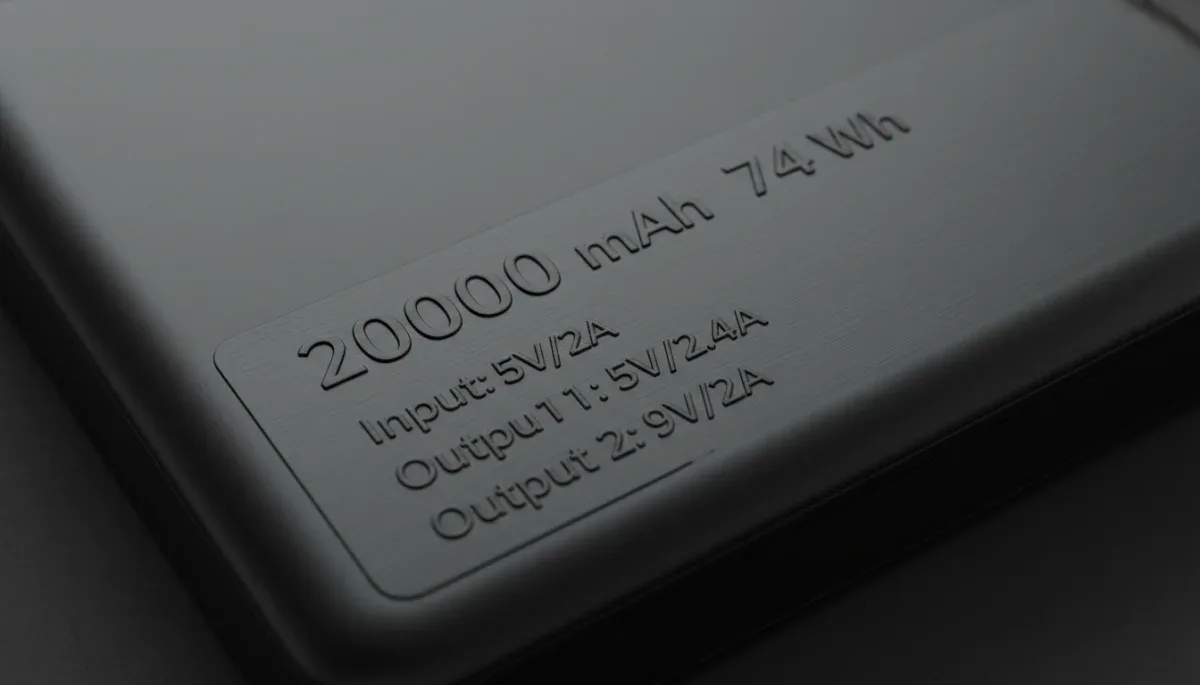
Ensure that the watt-hour rating is clearly printed on the physical casing of your battery pack. Airport security personnel may confiscate power banks that lack legible capacity markings during routine checkpoint screenings.
Reviewing merchant warranties and return policies
Online marketplaces feature a vast array of third-party vendors selling white-label accessories. When shopping on value-oriented retail platforms, checking the warranty length and merchant return policy is critical. Battery defects may not appear immediately; poor cell balancing or degraded holding capacity often manifests after twenty or thirty recharge cycles.
Reputable accessory brands typically offer an explicit manufacturer warranty ranging from 12 to 24 months. Read customer service terms carefully to confirm who covers return shipping costs in the event of a warranty claim. For third-party marketplace sellers, confirm whether the purchase is backed by the host platform's buyer protection program.
Shopping safeguards to inspect
- Return window duration: Standard retail return periods typically span 30 days from delivery for electronics.
- Direct warranty backing: Manufacturer-backed warranties with accessible customer support contact channels.
- Hazardous materials return rules: Carrier restrictions that may complicate shipping defective lithium batteries back through standard mail.
- Seller profile transparency: Detailed business registrations and sustained review histories on the marketplace hosting the listing.
Review the exact return conditions on the merchant's checkout page before completing payment. Knowing your recourse if a power bank underperforms ensures you do not get stuck with an unusable brick.
At a glance
| Specification factor | What to check |
|---|---|
| Real usable capacity | Expect 60% to 70% of stated mAh due to 3.7V to 5V/9V voltage conversion. |
| Port wattage output | Verify single-port maximum output rather than combined total device power. |
| Flight legal limits | Keep ratings under 100 watt-hours (under ~27,000 mAh) for standard carry-on use. |
| Safety compliance | Look for UL 2056, UL 1642, or ETL marks stamped directly on the casing. |
Frequently asked questions
Can a 20,000 mAh power bank charge a laptop?
Yes, but only if the battery's USB-C port supports adequate Power Delivery wattage. Most laptops require at least 45W to 65W output to charge effectively, so a 20,000 mAh battery limited to standard 18W phone charging will not power the computer.
Why does my power bank get warm during fast charging?
Energy conversion and internal resistance naturally generate heat when transferring high currents. While slight warmth is normal during rapid charging, the battery pack should never become uncomfortably hot to the touch or emit chemical odors during operation.
How do I convert milliampere-hours to watt-hours?
Multiply the milliampere-hour rating by the cell's nominal voltage (usually 3.7V), then divide the result by 1,000. For example, a 10,000 mAh pack multiplied by 3.7V equals 37,000 mWh, which divides into exactly 37 watt-hours.
Does pass-through charging damage the power bank battery?
Pass-through charging can increase internal heat because the unit charges its cells while powering external electronics. If the power bank lacks robust thermal management, using pass-through charging regularly can accelerate long-term cell degradation over time.
The bottom line
Comparing power bank specifications comes down to looking past bold milliampere-hour headlines and evaluating usable watt-hours, single-port output wattage, and verified safety certifications. Matching charging protocols to your devices ensures your gear powers up safely at intended speeds. Before finalizing your online purchase, check the physical product label specifications shown in the listing images to confirm the single-port output wattage and watt-hour ratings match your exact devices.

Written by
Mariana Viana
Mariana Viana covers discounts and savings for S2YOU, from coupons and cashback to free-trial and sample programs. She compares offers and program rules across retailers, and checks every detail on the brand's official site before publishing.