
How to read clothing care labels on delicate items
Advertisements
Reading clothing care labels correctly prevents shrinkage, fiber distortion, and color bleeding before you wash fragile garments. In the United States, the Federal Trade Commission requires apparel manufacturers to attach permanent tags that state at least one safe cleaning method, providing a dependable blueprint for maintaining your wardrobe.
This reference helps shoppers manage synthetic blends, sheer knits, and delicate natural fibers without relying on guesswork. The catch is that care tags list only the minimum safe cleaning route recommended by the manufacturer, which means following the symbols strictly protects your garments but may require adjusting your standard laundry habits.
Understanding the five core care symbol categories
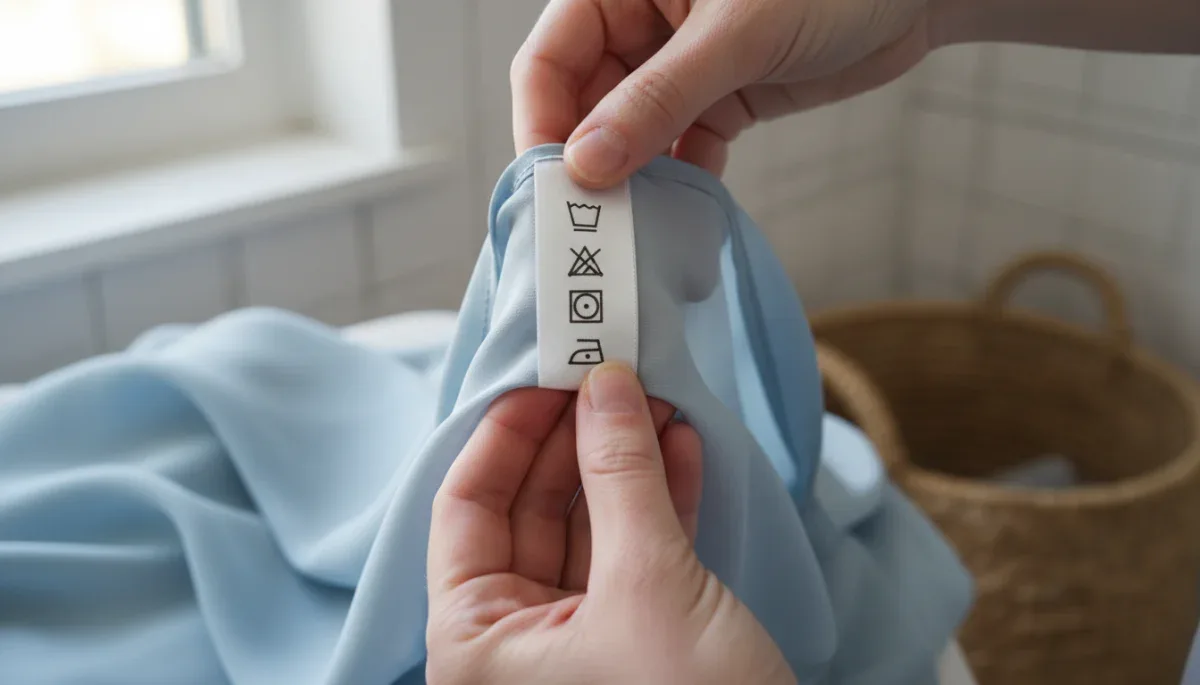
Standardized laundry icons follow a set order across domestic and international apparel tags. The standard system established by ASTM International in the United States and the International Organization for Standardization overseas organizes garment care into five universal shapes: a wash tub, a triangle, a square, an iron, and a circle. Reading them in sequence tells you how to wash, bleach, dry, iron, and professionally clean any piece of clothing.
Advertisements
When you inspect clothing care labels, the order of these symbols almost always remains uniform from left to right. The washtub indicates water temperature and machine action limits. The triangle explains whether chlorine or non-chlorine bleach is safe for the dye and fiber composition. The square governs drying instructions, including machine heat or air-dry methods. An iron shape indicates pressing limits, while a circle outlines dry-cleaning or wet-cleaning protocols.
Advertisements
Standard sequence of laundry care symbols
- Washtub: Specifies water washing method, maximum temperature, and cycle intensity.
- Triangle: Outlines whether bleach can be used safely without degrading fabric dyes.
- Square: Directs tumble drying temperatures or specifies air-drying requirements.
- Iron: Sets the safe soleplate temperature limit and steam permissions.
- Circle: Advises professional cleaners on chemical solvent selection and processing.
Failing to interpret these shapes in order can lead to accidental fabric damage. For example, mistaking a tumble-dry square for a dry-clean circle often results in ruined synthetics or shrunken wool sweaters. Taking a moment to read the tag from left to right establishes a clear baseline for safe laundering.
Decoding water temperatures and cycle bars

The washtub icon communicates both heat thresholds and mechanical agitation levels through a system of dots and horizontal bars. A simple open washtub indicates that standard machine washing is safe, while a hand submerged in the water signals that the item requires gentle hand washing only. An "X" drawn across the tub means the item should not be washed in water under normal household conditions.
Water temperature is communicated either through numerical Celsius markings or a series of dots placed inside the tub icon. One dot represents cold water, typically between 65 and 85 degrees Fahrenheit (20 to 30 degrees Celsius). Two dots indicate warm water around 105 degrees Fahrenheit (40 degrees Celsius), while three dots designate hot water up to 120 degrees Fahrenheit (50 degrees Celsius). Delicate fabrics such as rayon, modal, and fine wool blends usually display one dot to prevent thermal fiber shock.
Reading agitation bars beneath the washtub
- No bar beneath tub: Normal wash cycle with standard agitation and regular spin speed.
- One horizontal bar: Permanent press cycle with reduced agitation to minimize wrinkling.
- Two horizontal bars: Gentle or delicate cycle with slow mechanical action and short spin.
- Hand in tub: Manual washing in a basin without machine agitation or wringing.
Observing the bars underneath the washtub is critical for fragile items. The double bar tells you that high-speed spinning will pull seams apart or cause surface pilling. When washing budget-friendly delicate items, choosing a delicate cycle or hand-washing routine safeguards the garment against physical wear.
Interpreting drying and bleaching instructions
Drying symbols govern how heat and mechanical tumbling should be applied once the wash cycle finishes. A square with an inscribed circle indicates machine tumble drying. Similar to the washing symbols, dots inside the circle represent heat intensity: one dot for low heat, two dots for medium heat, and three dots for high heat. A solid black circle inside the square indicates no heat or an air-fluff setting.
Air-drying instructions appear as lines inside the square without a circle. A single horizontal line across the center of the square means the garment must dry flat, which prevents heavy knits from stretching out of shape. Three vertical lines inside the square designate drip drying without prior spin extraction. A curved line draped from the top of the square represents line drying, while diagonal lines in the upper corner advise drying in the shade to prevent ultraviolet fading.
Deciphering bleach symbols
- Clear triangle: Any commercial bleach product, including chlorine, may be used.
- Triangle with diagonal lines: Use only non-chlorine, oxygen-based bleach to protect colors.
- Solid triangle with an X: Do not bleach under any circumstances.
Bleaching mistakes are irreversible on delicate synthetics and dyed cottons. Chlorine bleach rapidly breaks down spandex fibers, resulting in loss of elasticity and yellowed patches. Checking the triangle on your clothing care labels ensures you do not inadvertently destroy delicate seams and stretch panels.
Managing ironing and professional cleaning tags
Ironing icons prevent scorch marks, surface glazing, and melted synthetic fibers by designating maximum soleplate temperatures. The iron symbol uses the standard dot system: one dot indicates low heat up to 230 degrees Fahrenheit (110 degrees Celsius), suitable for acrylic, nylon, and acetate. Two dots permit medium heat up to 300 degrees Fahrenheit (150 degrees Celsius) for polyester and silk blends. Three dots allow high heat up to 390 degrees Fahrenheit (200 degrees Celsius) for linen and heavy cotton.
Steam permissions are marked directly beneath the iron icon. An iron with crossed-out lines protruding from the bottom prohibits the use of steam, which is common on fabrics susceptible to water spotting or heat-induced puckering. An "X" over the entire iron indicates that the garment must not be pressed at all, a frequent instruction for textured fabrics, metallic prints, and heat-sensitive pleats.
Common dry-cleaning designations
- Plain circle: Dry clean only using standard commercial solvents.
- Circle with an X: Do not dry clean; chemical solvents will degrade the fabric or trims.
- Circle with letter P: Professional cleaning with perchloroethylene or petroleum solvents.
- Circle with letter F: Professional cleaning using flammable petroleum solvents only.
- Circle with letter W: Professional wet cleaning permitted under controlled water processes.
Understanding these specialized symbols helps you decide whether an item is practical for your routine before you buy it. If an inexpensive fashion find requires professional dry cleaning, ongoing maintenance costs may quickly exceed the original purchase price.
Handling delicate fabrics without clear tags
Vintage finds, secondhand garments, and imported clothing sometimes lack legible tags due to wear or removal. In these situations, identifying the base fiber helps you determine a safe baseline cleaning protocol. Natural protein fibers such as silk and wool require cool water, neutral detergents, and flat air-drying to avoid shrinkage and felting.
Cellulose-derived synthetics like rayon, viscose, and modal lose up to half their structural strength when wet. Always treat untagged rayon garments as fragile items by washing them in cold water inside a mesh laundry bag, avoiding twisting or wringing, and reshaping them on a flat drying rack. Synthetic fibers like polyester and nylon are naturally resilient but melt under moderate heat, making air-drying the safest universal choice.
Universal rules for washing untagged garments
- Use cool water: Wash at or below 85 degrees Fahrenheit to prevent shrinkage and bleeding.
- Select gentle detergents: Use enzyme-free or mild liquid formulas designed for fine washables.
- Enclose in mesh bags: Isolate garments to prevent snagging on zippers or rough textures.
- Air-dry flat: Eliminate tumble-dry heat risks by laying wet items on clean towels.
When in doubt, testing a hidden inner seam with a damp white cloth reveals whether the dye is colorfast. If color transfers onto the cloth, avoid soaking and clean the piece separately in cold water.
At a glance
| Care factor | What to know |
|---|---|
| Wash dots | One dot means cold water, two dots mean warm, and three mean hot. |
| Underscore bars | Double bars under any icon dictate a gentle, low-agitation cycle. |
| Square markings | Lines inside squares specify air-drying; circles indicate tumble drying. |
| Circle icons | Circles govern commercial dry cleaning and specify permitted solvents. |
Frequently asked questions
What does dry clean only actually mean on care tags?
"Dry clean only" indicates that the garment manufacturer has verified professional dry cleaning as the only safe maintenance method. While some simple unlined items can occasionally tolerate careful hand washing, lined blazers, structured dresses, and delicate silks risk severe shrinkage, water spotting, or structural collapse if washed in water.
How do I know if an item must dry flat?
An item must dry flat when the square care symbol contains a single horizontal line across its center. This instruction is common for knits and open-weave fabrics that stretch or distort under their own water weight when hung on standard clotheslines or hangers.
What is the difference between chlorine and non-chlorine bleach symbols?
A clear triangle permits all household bleaches, including chlorine formulas. A triangle filled with diagonal parallel lines permits only non-chlorine or oxygen-based bleach, which protects dyed fabrics and synthetic fibers from chemical degradation and permanent yellowing.
Can I machine wash garments marked with a hand-wash symbol?
You should generally avoid machine washing hand-wash items unless your machine offers a certified hand-wash cycle. Even delicate machine cycles create mechanical friction that can tear lace, stretch fine knits, or cause delicate rayon seams to fray prematurely.
The bottom line
Reading clothing care labels methodically protects your delicate garments from accidental shrinkage, melting, and dye transfer. Paying close attention to water temperature dots, cycle bars, and air-drying lines ensures that budget-friendly fashion and delicate wardrobe staples retain their fit and texture over time. Before laundering any delicate item, always verify the permanent inner tag to confirm whether water washing or professional cleaning is recommended.

Written by
Lucas Bastos
Lucas Bastos covers electronics and gadgets for S2YOU, from audio, smart-home and phone accessories to product-testing programs for tech. He compares specs, prices and return policies across retailers, and checks every detail on the brand's official site before publishing.