
How coupon stacking policies work in retail stores
Advertisements
Coupon stacking policies determine whether a retail store allows a customer to apply more than one discount offer to a single item or transaction. Learning how these rules operate helps regular shoppers reduce everyday expenses on groceries, household goods, and apparel, while the catch is that retailers frequently update their software systems to block combinations that their current written policies forbid.
Every major retail chain maintains its own set of rules regarding which coupon types can be merged together at checkout. While the basic concept involves pairing a brand-issued discount with a retailer-issued incentive, checkout registers rely on strict automated logic that checks barcodes, product codes, and purchase minimums before granting any price reduction. Understanding the precise distinction between coupon categories and knowing the exact order in which registers calculate savings prevents unexpected checkout surprises and ensures that transactions proceed smoothly.
The difference between manufacturer and store coupons
At the foundation of all coupon stacking policies lies the technical division between manufacturer coupons and store-issued coupons. Manufacturer coupons are created and funded directly by the consumer packaged goods companies that make the merchandise, such as food processors, cosmetic brands, or household cleaning manufacturers. When a cashier scans a manufacturer coupon, the store submits that voucher to a clearinghouse to receive full monetary reimbursement from the maker of the product, often alongside a small handling fee. Because the third-party brand covers the cost of this specific markdown, the retailer incurs no financial loss when accepting legitimate manufacturer coupons that meet printed terms.
Advertisements
Store coupons, on the other hand, represent internal price adjustments created and funded entirely by the retailer itself. These discounts appear in weekly print circulars, arrive via email newsletters, or sit within a retailer mobile application as digital account rewards. Retailers design these promotions to draw foot traffic into brick-and-mortar locations or clear slow-moving inventory from storage rooms. Because the retailer absorbs the entire financial cost of a store discount, it maintains absolute discretion over how, when, and where shoppers can redeem those specific offers.
Advertisements
True stacking occurs when a retailer permits a customer to apply one manufacturer coupon and one store coupon to the exact same physical product. In this scenario, the manufacturer pays for one portion of the price reduction, and the merchant absorbs the other portion. However, almost every national retail policy explicitly bans stacking two manufacturer coupons on a single item, even if one coupon is on paper and the other is loaded to a mobile loyalty account. Automated point-of-sale registers track the universal product code of the purchased merchandise, meaning an attempt to attach duplicate manufacturer promotions to one item will cause the secondary coupon to trigger an error code on the cashier screen.

How major national retailers define stacking
Written retail policies vary significantly across big-box chains, pharmacy networks, and regional supermarkets. At big-box department retailers like Target, the published coupon policy allows shoppers to combine one manufacturer coupon, one Target store coupon, and any applicable percentage-off promotional discounts found in the retailer circle loyalty account. This framework provides clear boundaries for stacking, but the retailer limits redemption to one manufacturer coupon per physical item, and registers will automatically adjust the value of any coupon downward if its face value exceeds the remaining purchase price of the qualifying merchandise.
Pharmacy chains, including CVS and Walgreens, operate complex loyalty ecosystems that allow multiple discount layers. At CVS, shoppers frequently combine manufacturer paper coupons with printable store coupons from the in-store coupon kiosk, alongside digital store offers and earned loyalty rewards currency. At Walgreens, shoppers encounter both manufacturer digital coupons and monthly savings booklet offers, which function as store coupons. Walgreens registers apply store booklet coupons across every qualifying item in an order, while manufacturer coupons apply strictly to individual matching products on a one-to-one basis.
In contrast, warehouse clubs and discount grocers take a far more restrictive approach to external savings vouchers. Wholesale clubs such as Costco do not accept external manufacturer paper coupons at all, choosing instead to apply instant in-house manufacturer rebates automatically to membership accounts at the register. Discount grocers like Aldi keep retail prices low by stripping away coupon processing infrastructure entirely, refusing all manufacturer and third-party offers. Regional supermarket chains generally permit pairing one manufacturer coupon with one store circular coupon, though several grocery chains have phased out legacy practices such as doubling coupon face values at store expense.
Standard retailer stacking permissions
- Big-box chains typically permit one manufacturer coupon plus one store-level coupon per item.
- National pharmacy chains allow combining manufacturer discounts with store rewards currency and account coupons.
- Warehouse wholesale clubs operate closed loyalty systems that exclude external paper vouchers.
- Deep-discount grocery grocers universally prohibit external manufacturer coupons to minimize register processing costs.
Digital coupons versus paper coupons at checkout
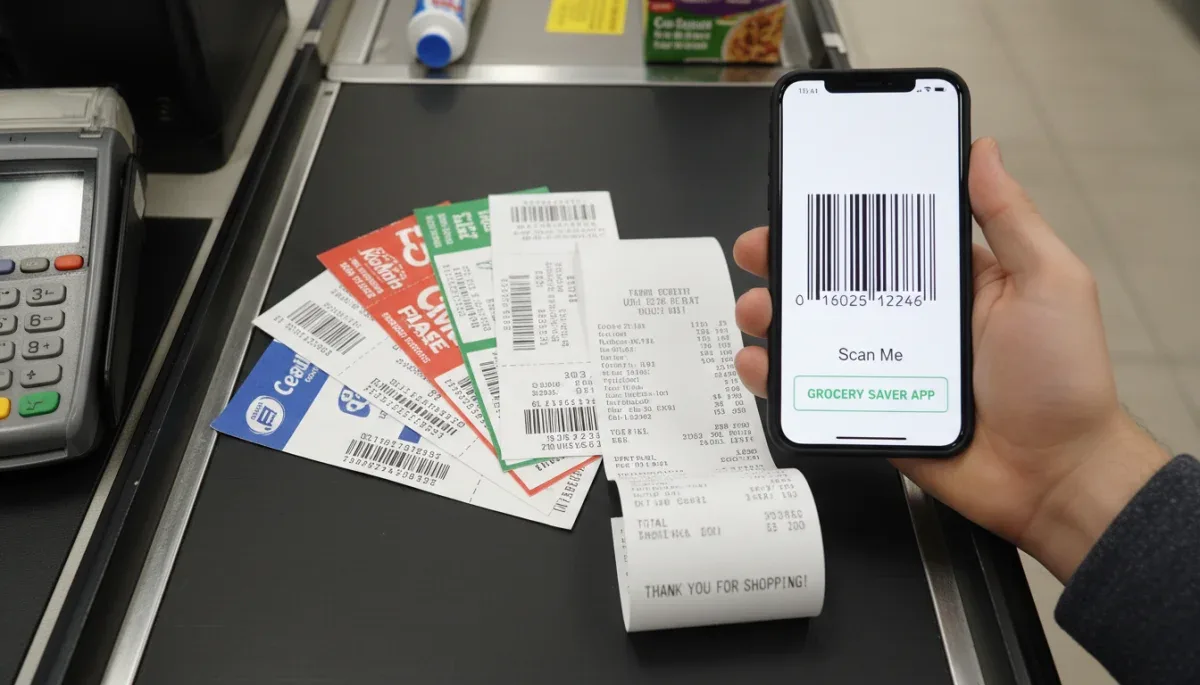
The widespread shift from traditional newsprint inserts to smartphone applications has completely altered how registers process coupon stacking policies. Digital coupons are accessed through retail mobile apps and clipped directly to a shopper loyalty account or telephone number. While many shoppers assume that a digital coupon functions identically to an internal store promo, the majority of digital coupons visible in retailer applications are actually digital manufacturer coupons funded by third-party brand makers. Consequently, a digital coupon in your app cannot be combined with a paper coupon clipped from a weekend newspaper on that exact same item, as doing so constitutes an attempt to use two manufacturer subsidies on a single purchase.
Modern point-of-sale systems are programmed with digital clearinghouse safeguards that communicate with manufacturer databases in real time. When a cashier scans your loyalty barcode or you enter your mobile phone number at the payment terminal, the register cross-references the scanned inventory against your digital account wallet. If you attempt to hand the cashier a paper manufacturer coupon after a digital manufacturer offer has already attached itself to that item, the register software will reject the paper slip with an alert message indicating that a coupon has already been redeemed for that specific line item.
To navigate the intersection of digital and physical savings, shoppers must read the identifying text on every digital coupon within their smartphone account. If the digital offer contains a disclaimer stating that it is a manufacturer coupon, it occupies the single manufacturer slot for that product. If the listing states that it is a store coupon, exclusive loyalty reward, or departmental percent-off deal, it occupies the store-level slot and can legally stack alongside a physical manufacturer coupon, provided the retailer published rules explicitly permit cross-format stacking.
The checkout calculation order and minimum spend thresholds
The mathematical sequence in which discounts are applied can substantially influence whether stacking is successful, especially when promotions require a minimum spending threshold. When a store advertises a general promotion, such as fifteen dollars off a fifty-dollar purchase, the register software calculates that fifty-dollar baseline before or after other coupons based on programmatic rules programmed into the central checkout operating system.
If a retailer checkout system evaluates the minimum spending requirement before subtracting individual item discounts, you can reach the qualifying threshold with the gross price of the items and still redeem individual manufacturer vouchers. However, if the register system calculates thresholds after subtracting product-level coupons, applying a manufacturer coupon could drop your total expenditure below the required spending limit, causing the overarching departmental or storewide discount to void itself immediately on the payment terminal.
Percentage-off coupons introduce another layer of operational complexity at the cash register. In most retail configurations, percentage-off store coupons calculate savings strictly based on the net balance remaining after all individual item manufacturer coupons and store promotional reductions have been deducted. If an item costs ten dollars and you present a two-dollar manufacturer coupon, a twenty percent store discount coupon will calculate twenty percent off the remaining eight dollars rather than the initial ten-dollar shelf price, reducing the item by one dollar and sixty cents instead of two dollars. Reviewing receipt line items reveals the exact mechanical sequence executed by the register.
Standard checkout calculation sequences
- Storewide percent-off sales and automatic buy-one-get-one promotions modify initial shelf prices.
- Item-level store coupons and departmental promotional codes deduct from the qualifying line items.
- Manufacturer paper or digital coupons apply directly against individual qualifying products.
- Transaction-level threshold coupons deduct from the cumulative total if the spend requirement is satisfied.
- Loyalty store rewards currency and gift cards apply as cash equivalents to pay the remaining balance.
Restrictions, return clawbacks, and coupon overage rules
Retail coupon policies contain extensive fine print outlining specific operational restrictions designed to prevent merchant financial loss and avoid inventory depletion. One universal clause across major retail stores is the limitation on identical coupons in a single transaction. Even when a coupon stacking policy permits merging store and manufacturer discounts, the manufacturer voucher almost universally states that shoppers may redeem no more than one, two, or four identical coupons for the same product in a single shopping trip, regardless of how many individual items are placed on the conveyor belt.
Another critical policy area involves coupon overage, which occurs when the face value of a coupon exceeds the retail cost of the product being purchased. For example, if a travel-sized bottle of shampoo sells for one dollar and twenty-five cents, and a shopper presents a manufacturer coupon valued at two dollars, an overage of seventy-five cents exists. In past decades, several national retailers would hand cash back to the shopper or apply that surplus credit toward the remainder of the grocery cart. In modern retail environments, almost every national chain prohibits cash back on overage; registers automatically down-code the coupon value to match the exact retail price of the merchandise, reducing the item to zero dollars while eliminating any residual balance.
Merchandise returns represent another area where coupon stacking rules carry lasting financial consequences. When you return an item purchased with stacked discounts, retail policies dictate that you do not receive a cash refund for the coupon value. Instead, the merchant calculates the net amount actually paid out of pocket after all promotional deductions were processed, and that reduced balance is refunded to your original payment method. Furthermore, if the returned merchandise formed part of a tiered transaction threshold that triggered a larger store coupon, the store customer service system may prorate the reduction across all items or claw back the threshold savings entirely from the final refund balance.
At a glance
| Rule factor | What to know |
|---|---|
| Manufacturer limit | Registers permit only one manufacturer coupon per physical item, regardless of whether it is paper or digital. |
| Store coupon combining | Retailers that allow stacking permit one store-issued discount to pair with one manufacturer discount per item. |
| Coupon overage handling | Most major chains automatically adjust coupon values down to the item price and no longer distribute cash back. |
| Spend threshold timing | Stores calculate minimum purchase requirements either before or after item discounts based on their software rules. |
Frequently asked questions
Can you stack two digital coupons on the same item?
No, you cannot stack two digital coupons on the exact same product if both offers are classified as manufacturer promotions. Retailer smartphone apps connect directly to clearinghouse databases that reject duplicate manufacturer funding on one barcode, though you can combine a digital store reward with a digital manufacturer offer where permitted.
What happens if a coupon is worth more than the item price?
The register will adjust the coupon value downward to match the price of the item so that the product becomes free. Major retail policies no longer allow cash overage or store credit balances resulting from coupons that exceed the retail price of the merchandise.
Do clearance items qualify for coupon stacking?
Clearance items qualify for manufacturer coupons if the item matches the exact size and variety listed on the voucher, but many retail store policies explicitly exclude clearance merchandise from receiving additional store coupons or departmental percentage discounts. Always verify the printed exclusions on the promotional voucher.
Why did the register reject my paper coupon after scanning my app?
The register rejected your paper coupon because a digital manufacturer coupon clipped to your store account had already attached itself to that item. When an account-linked manufacturer discount is processed, the system software locks that purchase against any additional physical manufacturer coupons for that specific product.
The bottom line
Coupon stacking policies offer a structured, legitimate way to multiply savings by pairing external manufacturer funding with internal retailer promotions on everyday purchases. Success requires recognizing that you can never apply more than one manufacturer discount to an individual item, regardless of whether you present a paper slip or scan an app barcode. Before planning a stacked transaction, verify the current coupon policy published on the retailer official website, as individual stores retain the final authority to reject combinations that conflict with automated checkout guidelines.

Written by
Rita Luiza
Rita Luiza covers home and kitchen for S2YOU, from everyday essentials and small appliances to product-testing panels for household goods. She compares prices, warranties and return policies across retailers, and checks every detail on the brand's official site before publishing.